
Daphne Directory Collections by Year
The strongest proven Daphne city directory list comes from the Alabama Department of Archives and History, or ADAH. Its LPR104 inventory identifies five combined Fairhope-Daphne volumes, while other repositories add regional phone books and broader spans. A holdings statement is evidence that a repository has material, not proof that each year in a range exists. Contact staff before travel, especially when a guide gives only starting and ending years.
| Collection | Years | Where Held | Access |
|---|---|---|---|
| Fairhope-Daphne city directories | 1965, 1967, 1989, 1991, 1996 | ADAH LPR104 | Reading room and reference request |
| Fairhope/Daphne directory span | 1978 to 1992 | USA McCall Library | Confirm issues with staff |
| Fairhope and Daphne directories | Years not listed online | Mobile Public Library | On-site reference |
| Eastern Shore telephone books | 1945, July 1949, plus an undated scan | Fairhope Single Tax scans and Library of Congress | Digital page review |
| Regional sample directory | 1950 | Fairhope Single Tax scan | Online entry-format example |
The 1965 combined volume has been identified as a Polk directory. The inventory does not name publishers for the other four exact holdings. Nor does it prove a continuous 1965 to 1996 run. That distinction keeps a missed volume from becoming a false claim that a Daphne resident vanished between two dates.
Five Daphne Volumes at ADAH
The ADAH city-directory finding aid places the 1965 and 1967 Fairhope-Daphne books in Box 58, the 1989 and 1991 books in Box 195, and the 1996 book in Box 236. Record those box references in a request. They are more useful than asking staff to search a broad Daphne subject because they point straight to known items.
These five years form the firm backbone of the Daphne city directory trail. They can reveal a household on two sides of a long gap, but they cannot show what happened during every year between. The Baldwin County Archives online records page adds land books, marriage material, historical cases, and photos that can test a clue found in a directory.
The source page below shows the county archive search environment. Its collections are useful when a directory supplies a surname or address but not the event that changed the household.
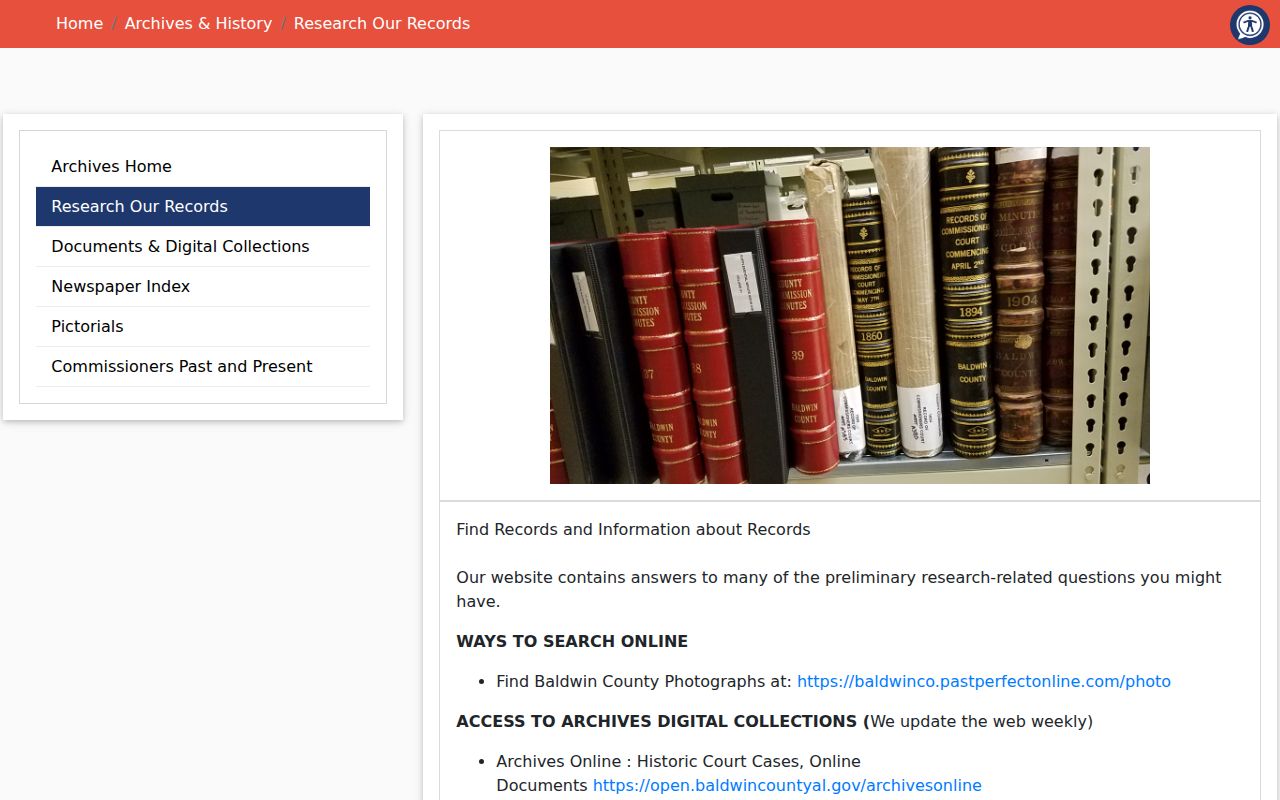
Search by type, subtype, description, or date range, then preserve the result location and description for a staff request.
Decode a Daphne Directory Entry
A 1950 regional directory shows the compact style likely to confront Daphne family researchers. A line can combine surname, given name or initial, spouse in parentheses, widow status, business or trade, and a house number with street. Telephone books use a different scheme: a person or business name, a residence marker such as “r,” locality or street, and telephone number. Read the key before expanding any mark.
| Printed field | What to copy |
|---|---|
| Name | Full spelling, initials, suffix, and line order |
| Spouse or widow mark | Name in parentheses or the exact widow notation |
| Trade or business | The printed role and named firm, without treating it as a home address |
| Residence | House number, street spelling, locality, and any residence mark |
| Telephone | Exchange and number exactly as shown |
Do not add an owner or renter label unless that volume defines a mark for it. The inspected Daphne-area sample supports names, spouse details, widow notation, work clues, and addresses. It does not support a general claim that each named person owned the property.
- Criss-cross directory
- A book arranged by street address or telephone number rather than only by surname. No dedicated Daphne run has been verified.
- Householder index
- An address-led list that names the person associated with a dwelling under that directory's rules.
- Abbreviation key
- The volume's own guide to short forms, symbols, locality marks, and entry conventions.
Daphne Names in Shore Directories
Early Daphne names may be hidden inside Eastern Shore and Fairhope material. The 1945 and July 1949 Fairhope telephone books contain Daphne entries, and a Library of Congress telephone-directory scan interfiles Daphne people and businesses within Fairhope exchange pages. Searchers should scan the relevant page range instead of waiting for a stand-alone Daphne heading.
This regional arrangement reflects how telephone service and commerce joined bay communities. It also changes the search method. Try the surname, then the locality tag, street, exchange, and nearby family names. If optical text search misses compressed print, inspect page images manually. The combined Fairhope-Daphne title is certain by 1965, but research found no official proof of the first dedicated Daphne book or the last printed year.
Daphne Directory Research Rooms
The Daphne Public Library keeps a locked Local History Collection founded on the Toulmin Collection. Its 2026 policy describes books, pamphlets, oral histories, maps, government publications, biographies, and personal papers tied to Daphne, the Eastern Shore, Baldwin County, and Alabama Territory. It does not publish a directory-year shelf list. Call 251-620-2500 before visiting the library at 2607 U.S. 98. Hours are Monday through Thursday 9 to 8, Friday 9 to 6, and Saturday 9 to 2.
For deeper genealogy, the policy itself points to Foley and Mobile. Mobile Public Library Local History and Genealogy confirms Fairhope/Daphne directories as well as yearbooks, maps, oral histories, vertical files, church sources, lineage material, and newspapers on microfilm. It is at 753 Government Street in Mobile, 251-494-2190, and is open Monday through Saturday 9 to 5.
Baldwin County Archives is the strongest county backstop. The archives visit page explains its research room and broad holdings.
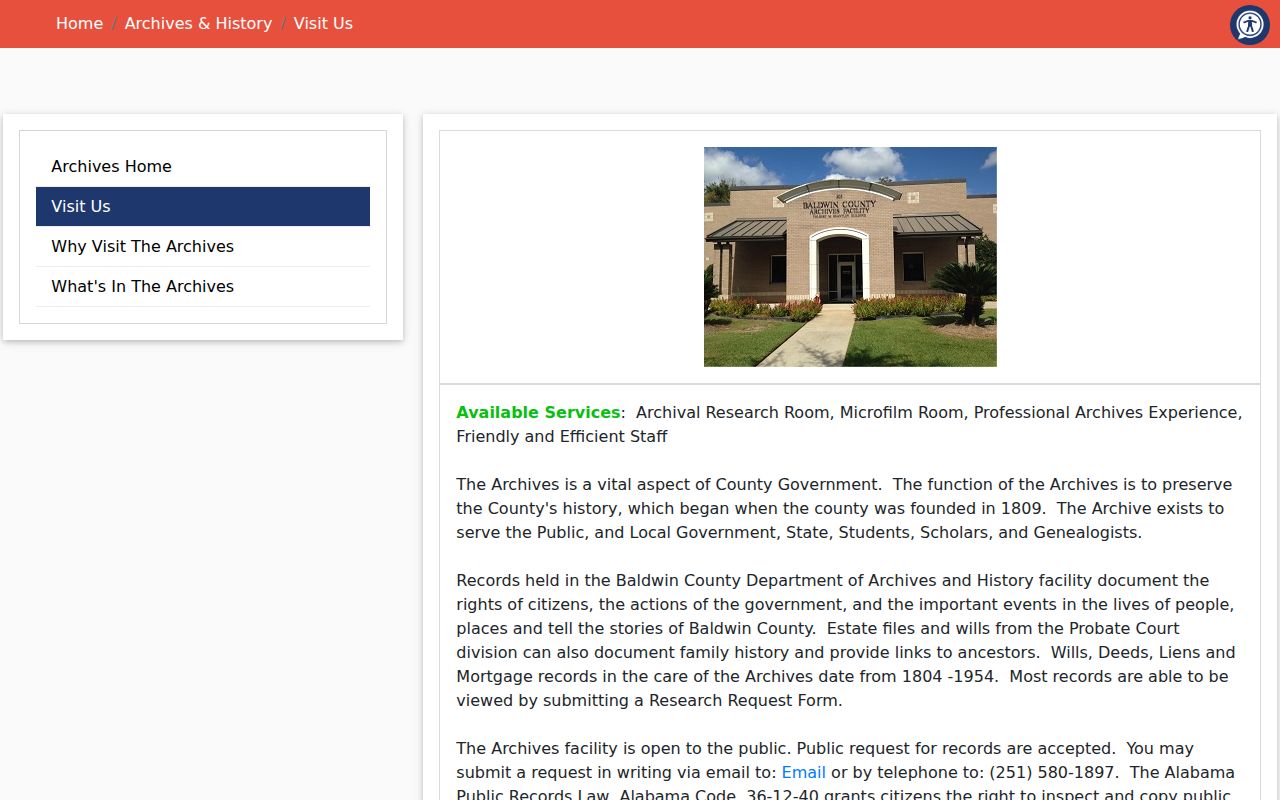
The research room is open Monday through Thursday 9 to 3, narrower than office business hours. Calling 251-580-1897 first can prevent a wasted trip.
Note: A directory-year question is narrow enough for staff to check before a visit, while a broad surname project may require paid research.
Daphne Records Moved at Night
Daphne served as the Baldwin County seat from 1868 to 1901. After lawmakers approved the move to Bay Minette, Daphne officials would not release the county and court records. Bay Minette officials removed them at night in October 1901. That episode explains why a Daphne city directory clue can lead north to county records in Bay Minette.
The story is about relocation, not a proven courthouse fire or destroyed archive. County materials survived across changing custodians and now help fill directory gaps. Baldwin County Archives has wills, deeds, liens, and mortgages dating from 1804 through 1954, including items older than Baldwin County's 1809 creation. It also holds county newspapers from 1890 through 2012, tax books from 1890 through 1979, and plats from 1830 through 1979.
That long survival is useful when the city directory shelf is thin. A tax book can keep a parcel in view. A newspaper can explain a move, death, or business change. A plat can preserve the legal identity of land when street wording differs.
Extend Daphne Directory Evidence
Directories are snapshots, so companion sources should answer what happened between them. Baldwin County Archives lists the Baldwin Times, Fairhope Courier, Onlooker, Islander, Eastern Shore Courier, Independent Courier, and Bulletin within its 1890 to 2012 newspaper holdings. The American Banner, serving the Black community, survives from September 1899 through February 1902. Notices, obituaries, society items, and business ads may connect a directory entry to relatives or a later address.
The county archive also holds selected census material, marriage records, land and tax series, lot books, plats, and historic cases. Modern birth and death certificates, adoption files, and post-September 1906 naturalization records are not held there. Those need the correct state or federal custodian.
The Baldwin Archives research service offers the fallback when an in-person visit is not practical.
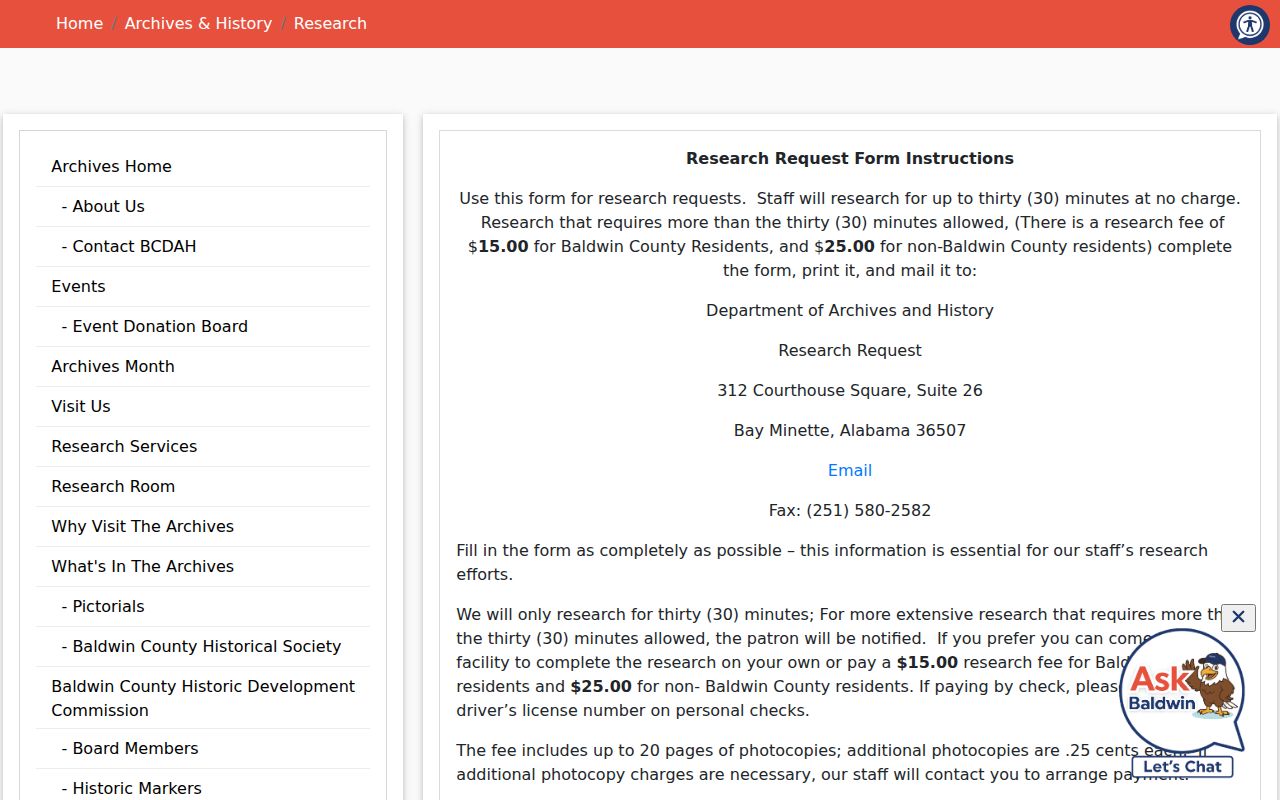
The first 30 minutes are free. Longer staff work costs $15 for Baldwin residents or $25 for nonresidents, includes 20 copies, and usually receives a response within 24 to 72 business hours.
Daphne Directory Evidence Timeline
The known record does not support a neat annual run, but it does support a careful timeline. Each point marks a verified holding or access milestone, not the only publication in that era.
| Year or span | Verified Daphne directory evidence |
|---|---|
| 1945 and 1949 | Fairhope telephone scans include Daphne locality entries |
| 1950 | Regional scan demonstrates entry style and abbreviations |
| 1965 and 1967 | Combined Fairhope-Daphne volumes listed at ADAH |
| 1978 to 1992 | McCall Library states a Fairhope/Daphne holdings span |
| 1989, 1991, 1996 | Additional exact combined volumes listed at ADAH |
The McCall span must not be read as an annual sequence. Ask for issue-by-issue confirmation. A telephone scan whose cover year has not been inspected should also remain undated in notes until staff or the image itself settles the date.
Trace Daphne Families Across Years
A strong Daphne city directory search preserves what each source truly says, then checks the result against a source created for another purpose. The goal is a coherent chain, not a stack of similar names.
- Begin with one verified combined volume. Copy the full entry, its page, printed year, box or repository, and abbreviation key.
- Check the next available volume in both directions. Record address, spouse, widow mark, trade, business, and telephone changes.
- Bridge early gaps with Eastern Shore telephone books. Scan Fairhope exchange pages for Daphne locality labels and nearby family names.
- Pair the entry with the 1950 federal census when dates fit. The 1960 census remains closed until 2032 under the 72-year rule.
- Use deeds, tax books, newspapers, obituaries, and probate files to explain a move, death, inheritance, or change in the printed household.
Disappearance from a directory has several possible causes: a skipped issue, a move, a changed surname, death, an unlisted telephone, or a location beyond that book's scope. Treat it as a clue. For a modern address-led method, the Daphne street directory explains current parcel and street evidence without replacing the historical shelf.