
Daphne Previous Residents by Era
Choose the source by date. A current parcel record is the best anchor even when the search concerns a much older Daphne home, because its legal description and identifiers can survive changes to the street label. Deeds establish transfers. Tax books support continuity between them. Directories and census schedules supply the household layer that ownership records cannot.
| Source | Years It Covers | Where Held | What It Shows |
|---|---|---|---|
| Official Records index and images | 1899 to present | Baldwin Judge of Probate | Grantor, grantee, instrument, date, legal description, image |
| Archive deeds, liens, mortgages | 1804 to 1954 | Baldwin County Archives | Earlier title and debt record series |
| Fairhope-Daphne directories | 1965, 1967, 1989, 1991, 1996 | Alabama Department of Archives and History | Name, household and address details depending on issue |
| McCall combined-town span | 1978 to 1992 | University of South Alabama McCall Library | Directory evidence; issue completeness unverified |
| Regional telephone books | 1945, 1949, plus an undated scan | Institutional digital collections | Daphne locality, address, and telephone entries |
| Federal census | Released schedules through 1950 | NARA and library databases | Household members and relationships at the census date |
| Tax books and plats | Tax 1890 to 1979; plats 1830 to 1979 | Baldwin County Archives | Assessed land continuity and lot layout |
| Building permits | Modern; start year not published | Daphne Building Inspection | Job site, permit, contractor, and work dates |
For a twentieth-century inquiry, begin with the deed chain and then check the nearest proven directory or census year. Before the online deed boundary, use the archive index and deed books. Never turn the five exact archive directory holdings into a continuous run.
Begin Daphne Past Residents at Land
Search today's address in the Baldwin property portal. Save the owner spelling, tax year, account, parcel, PIN, physical address, mailing address, subdivision, lot or block, and legal description. The parcel owner is not necessarily the current occupant, but that record supplies the stable keys needed to move backward.
A physical or situs address locates the land. A tax mailing address receives notices. When they match and a homestead indicator appears, the combination may support owner occupancy. It still cannot identify each person in the home. If the assessed owner is a trust, estate, company, or public body, inspect the deed rather than trying to turn the entity into an individual.
The process flow is simple: present address → parcel and legal description → current acquisition deed → earlier owner → occupancy evidence. That separation keeps previous residents from being confused with prior owners.
Trace Baldwin Deeds Backward
The Baldwin Official Records advanced search has separate grantor and grantee fields, date limits, document number, book/page, and subdivision or condo legal filters. A grantee receives an interest. A grantor transfers it. Walking the same seller backward as an earlier buyer builds the chain of title, the linked sequence of recorded ownership transfers.
- Use the property roll to identify today's assessed owner and the exact legal description.
- Search that owner as grantee. Open the acquisition deed and copy its grantor, recording date, instrument number, book/page, and legal description.
- Search the named grantor as grantee in an earlier date range. Use subdivision, section, condo legal, or direct citations when names collide.
- Repeat the loop. Inspect corrective deeds, releases, probate deeds, and quitclaim instruments around each transfer date before accepting the sequence.
- At the online boundary, move to office viewing stations or Baldwin County Archives deed indexes and books.
The advanced deed screen pictured below shows the structured fields that make a backward search more precise than a free-text address query.
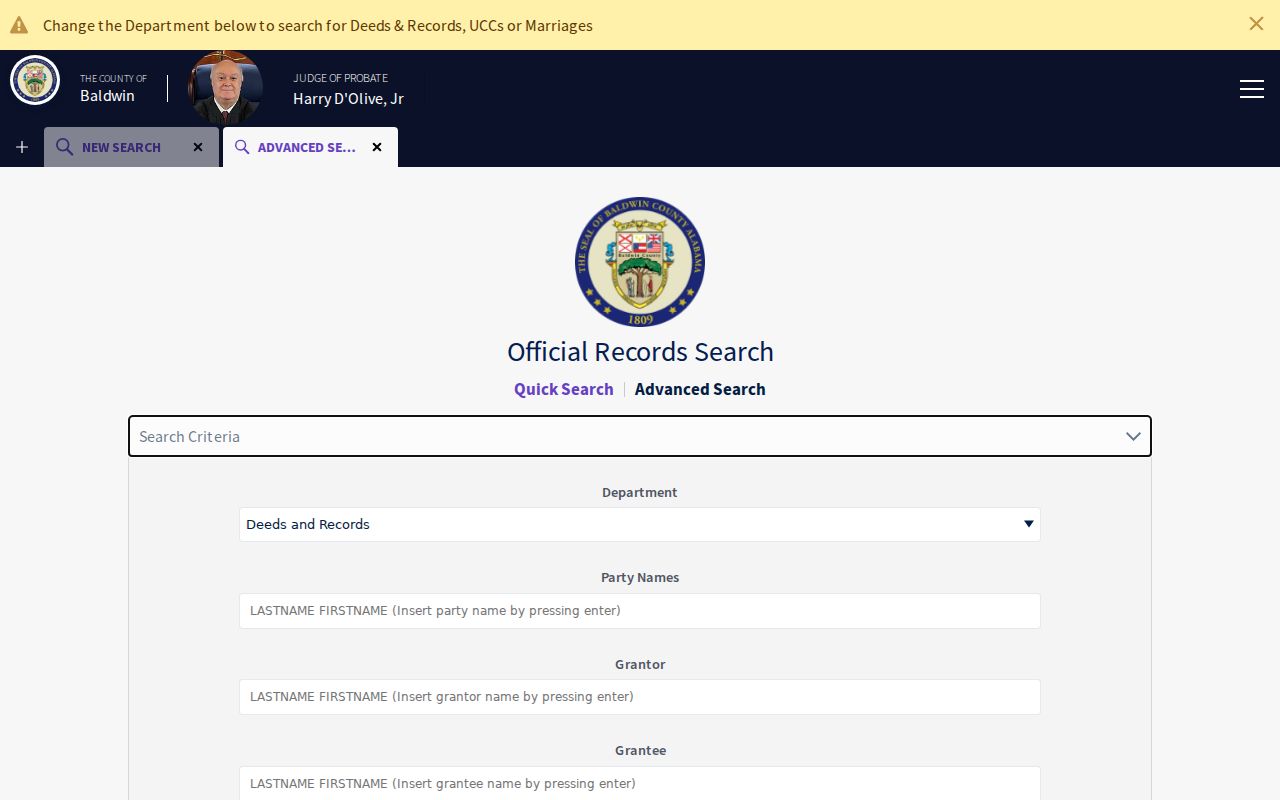
Its legal and citation fields are especially useful when one name appears on several unrelated Daphne parcels.
Daphne Previous Residents Before 1899
Baldwin's online deeds and mortgages begin at 1899, Book 1. That provides more than a century of online title work, but it is not the beginning of the county's surviving land trail. Baldwin County Archives reports wills, deeds, liens, and mortgages in its care from 1804 through 1954. Its records reach before Baldwin County was created in 1809.
The Archives holdings page shown here is the source for those dates and reading-room access.
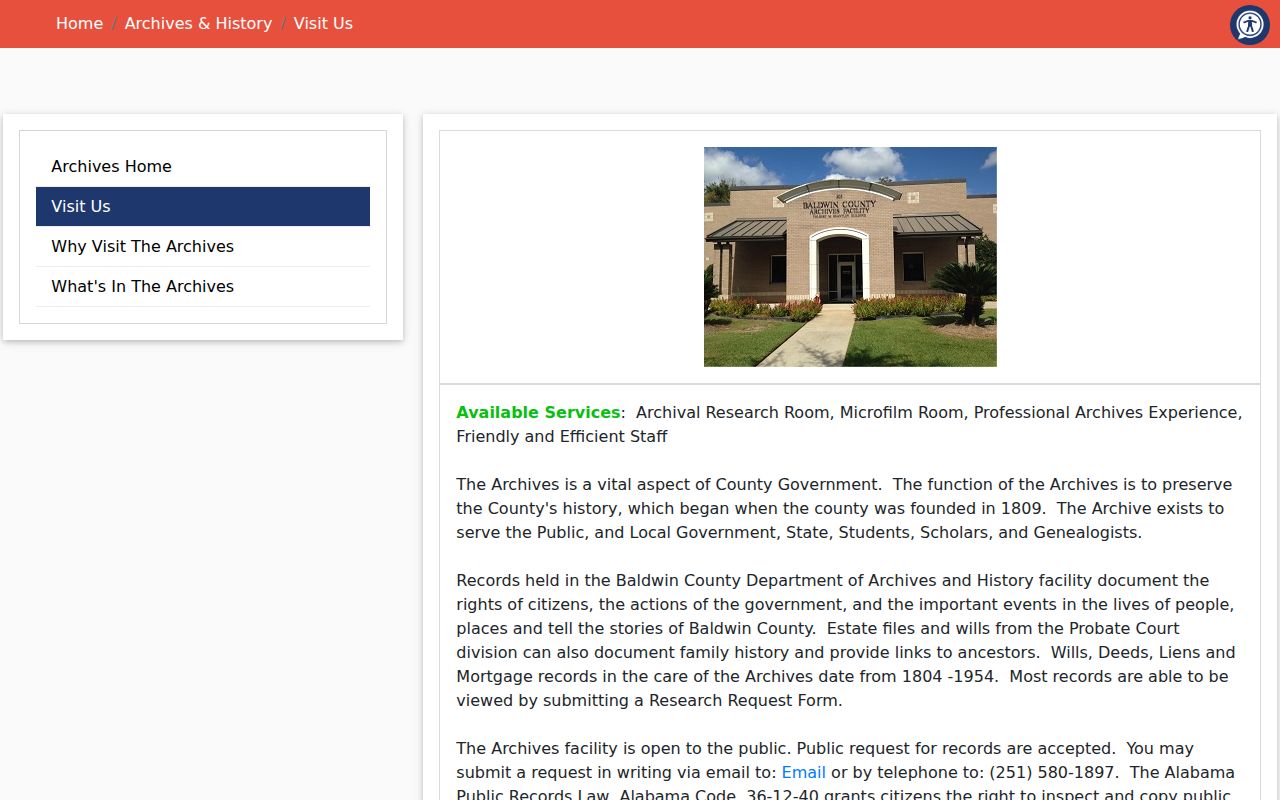
This offline backstop prevents an 1899 web cutoff from becoming a false end to the address history.
The research room is open Monday through Thursday from 9 a.m. to 3 p.m., while business hours are broader. Call 251-580-1897 before traveling. The first thirty minutes of staff research are free. Longer work costs $15 for Baldwin County residents or $25 for nonresidents, includes twenty photocopies, and has a stated response window of 24 to 72 business hours. The fee remains due even when no match is found.
Note: Arrive during research-room hours, not merely business hours, and bring exact names, dates, parcel details, and book or page references.
Decode Daphne Address History Terms
Old land records work better when each term stays tied to its legal role. A deed image can include spouses, notaries, witnesses, a preparer, and a return destination. Not every named person lived at the property. A mortgage can support timing, but it does not by itself show a change of ownership.
- Grantor and grantee
- The party transferring an interest and the party receiving it.
- Chain of title
- The linked sequence of deeds and other instruments that traces recorded ownership over time.
- Legal description
- The land description in the record, often a lot and block or measured boundary, which can outlast a street-name change.
- Criss-cross directory
- A directory organized by address or telephone rather than only by surname.
- Enumeration district
- The small area assigned to a census taker, useful for locating a home when an index or street label fails.
Copy language exactly before interpreting it. A deed return address can help follow a former owner, but it is a delivery field. A notary county identifies where an acknowledgment occurred, not where the signer lived.
Pair Daphne Owners and Occupants
Ownership answers only half of a previous-residents search. Directories, telephone books, and released census schedules can show who used the address. Verified Fairhope-Daphne volumes at the state archives cover five individual years. McCall Library reports combined-town directories from 1978 through 1992, but an issue-by-issue list is not published. Earlier Eastern Shore phone books can interfile Daphne entries among Fairhope exchange pages.
- Choose the closest proven directory year after a deed transfer and copy the entry exactly, including spouse, widow notation, telephone, address, and locality.
- Check the nearest released census schedule. Preserve the enumeration date and relationship terms because a census is one dated household snapshot.
- Use deeds and county tax books between directory or census years to keep the same parcel in view.
- When the name disappears, test later directories, newspapers, obituary material, probate files, and an estate conveyance before deciding why.
The 1960 census remains closed until 2032 under the 72-year rule. Post-1950 research therefore leans more on directories, deeds, taxes, newspapers, school publications, and probate. The Daphne city directory collections are treated separately so the backward address trail can stay focused on one house.
Bridge Daphne Previous Resident Gaps
Tax books and plats help when deeds are far apart. Baldwin County Archives holds tax books from 1890 through 1979, plats from 1830 through 1979, and lot books from 1919 through 1979. A plat translates the modern street into subdivision, lot, and block. Tax entries can support assessed-owner continuity, though they still do not prove everyone who occupied the home.
Daphne permit and inspection files add the structure timeline. Current inspection requests include a job-site address, subdivision, lot or phase, contractor, permit number, inspection type, and requested date. Use the Daphne public-record request for older permits or certificates that are not published. Permits can date additions or repair work; they generally do not identify renters.
No verified Daphne citywide renumbering event or Sanborn map run was found. Bridge a suspect address with legal descriptions, recorded plats, historical maps, and directory adjacency. Do not attach a made-up year to a change the records do not document.
Close Daphne Past Resident Trails
A coherent death or departure trail can join an address entry, later absence, obituary, probate filing, and estate deed. Baldwin Probate Court handles estates and wills, while older court and probate material rests at the Archives. An obituary may name relatives and places, but it is not a court finding. Confirm its claims through a vital, probate, land, or census record when possible.
This is also a practical heir-search path. Begin with the last confirmed address and identity. Check the death evidence, locate the probate case, identify the personal representative or named heirs in public portions of the file, and then inspect any estate conveyance. Some adoption, guardianship, trust, and other protected material may be closed or partly redacted.
A missing directory entry can mean a move, death, changed surname, unlisted phone, absent volume, or a place outside that issue's scope. If two explanations remain possible, mark the identity unresolved.
Note: Chronology and independent records matter more than a single matching name in an obituary, directory, or deed index.
Daphne Previous Residents Limits
Past owners and past residents are different groups. A deed proves a recorded transfer. A tax roll names the assessed owner or taxpayer. A directory may identify an occupant. A census reports a household on one enumeration date. None should silently stand in for the others.
Private utility and delivery data are not public resident lists. Driver address information is restricted. Protected voter details, sealed cases, adoption files, and other confidential records remain outside a normal address-history search. The lack of an online match may reflect a closed source or a gap, not the absence of a person.
Lawful use. Research Daphne previous residents for house history, genealogy, estate work, or personal curiosity. Do not use address evidence to stalk, threaten, harass, or track a living person.
End the trail with a source log. Record the date searched, custodian, exact citation, role proved, and any conflict. That is more honest and more useful than forcing uncertain evidence into a complete list of who lived here before.